Pediatric orthodontics in New Jersey
Dentistry for Children provides specialist pediatric orthodontic care at our Toms River, Howell, and Jackson locations, with free consultations for new orthodontic patients. Our orthodontists work alongside our pediatric dentists, so your child’s braces, retainer, and routine care are coordinated by a single team that already knows them.

When should my child see an orthodontist?
The American Association of Orthodontists recommends every child have their first orthodontic evaluation by age 7. By that age, enough permanent teeth have come in for an orthodontist to spot jaw, bite, and alignment issues early, often before they become visible to parents. Early evaluation doesn’t always mean early treatment. For many children, we simply monitor growth until the right time. For others, early intervention between ages 7 and 10 can prevent more complex treatment later.
What pediatric orthodontic treatment looks like
Pediatric orthodontics goes beyond straightening teeth. Our orthodontists focus on jaw development, bite alignment, airway health, and the overall growth of your child’s face and smile. Properly aligned teeth are easier to brush and floss, less likely to be fractured in sports or falls, and contribute to healthier breathing and speech.
Issues we evaluate and treat
- Underbite (lower front teeth ahead of upper front teeth)
- Overbite or deep bite
- Crossbite (jaw shifts to one side)
- Open bite
- Crowded or overlapping front teeth
- Teeth spaced too far apart or missing teeth
- Extra teeth
- Impacted teeth
- Thumb, finger, or pacifier habits that are affecting tooth or jaw growth
- Airway and breathing concerns related to jaw development
Our pediatric orthodontic services
- Free initial orthodontic consultations and evaluations
- Phase I early orthodontic treatment (typically ages 7 to 10)
- Phase II comprehensive treatment (typically ages 11 and up)
- Adolescent orthodontic treatment
- Traditional metal braces
- Clear or ceramic braces
- Palatal expanders
- HERBST appliances
- Retainers
- Space maintainers
- Orthodontic emergency care

Why parents choose us for pediatric orthodontics
Specialty-trained orthodontists
Our orthodontists complete additional years of training beyond dental school, dedicated specifically to bite, alignment, and jaw growth.
Free initial consultation
No-cost evaluation at Toms River, Howell, and Jackson to determine whether and when treatment makes sense.

Coordinated with your child’s dentist
Your child’s pediatric dentist and orthodontist share records and treatment plans, so nothing falls through the cracks.

Kid-friendly experience
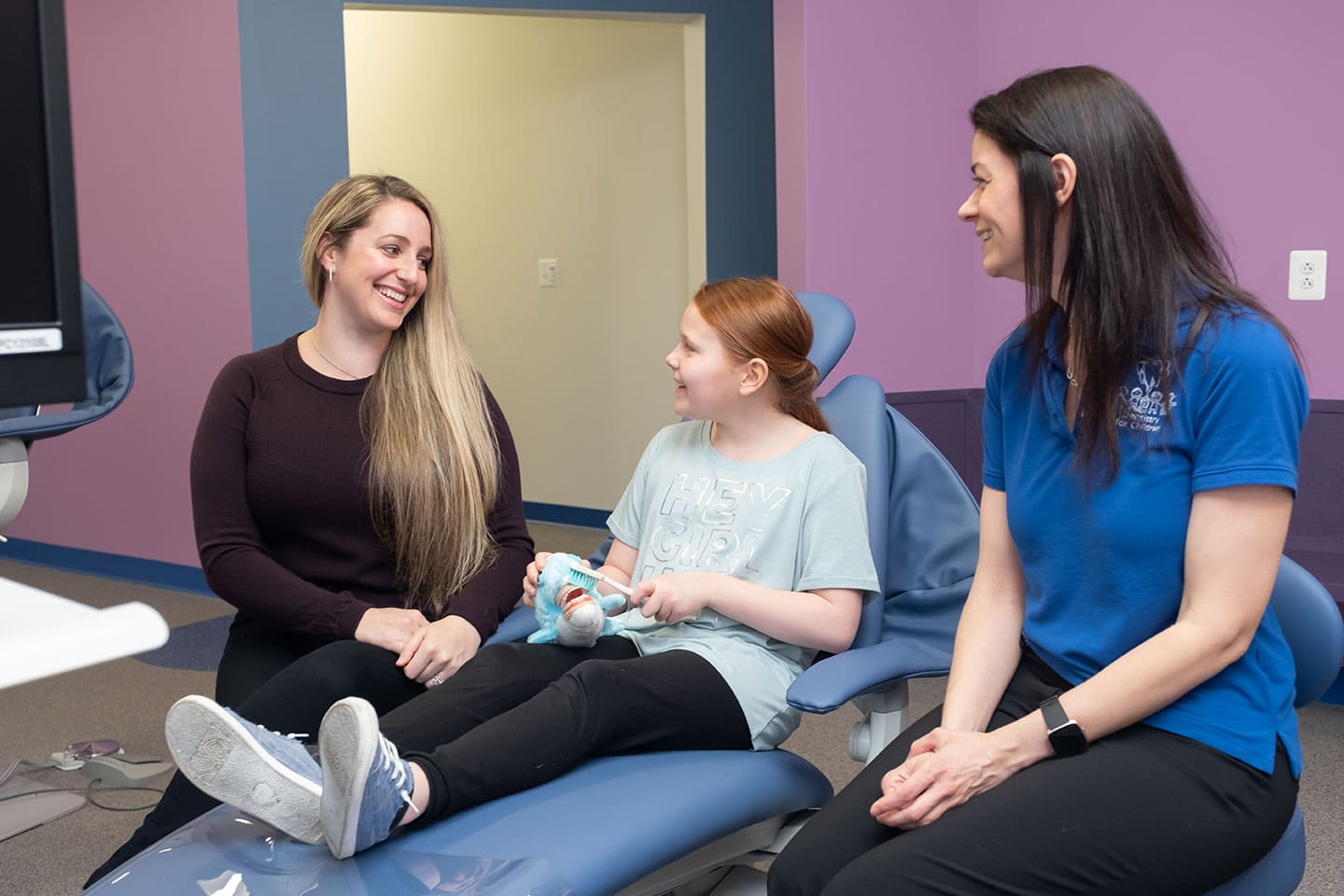
Every office is built around children, with pediatric-trained staff who know how to make orthodontic visits easy.
Frequently asked questions about pediatric orthodontics
Please feel free to contact the office if you are experiencing any discomfort or if you have any questions. Below are a few simple steps that might help if you are unable to contact us or if you need a “quick fix:”
Loose Bracket
Occasionally, a bracket may come loose. You can remove the loose bracket and save it in an envelope to bring to the office or leave it where it is, if it is not causing any irritation. Call the office as soon as possible in order for us to allow time to replace the bracket.
Poking Wire
If a wire is poking your child’s gums or cheek, there are several things you can try until you can get to the office for an appointment. First, try a ball of orthodontic wax on the wire that is causing the irritation. You may also try using a clean nail clipper or cuticle cutter to cut the extra piece of wire that is sticking out. Sometimes, a poking wire can be safely turned down so that it no longer causes discomfort. To do this you may use a pencil eraser, or some other smooth object, and tuck the offending wire back out of the way.
Wire Out of Back Brace
Please be careful to avoid hard or sticky foods that may bend the wire or cause it to come out of the back brace. If this does happen, you may use clean needle nose pliers or tweezers to put the wire back into the hole in the back brace. If you are unable to do this, you may clip the wire to ease the discomfort. Please call the office as soon as possible to schedule an appointment to replace the wire.
Poking Elastic (Rubber Band) Hook
Some brackets have small hooks on them for elastic wear. These hooks can occasionally become irritating to the lips or cheeks. If this happens, you may either use a pencil eraser to carefully push the hook in, or you can place a ball of orthodontic wax on the hook to make the area feel smooth.
Sore Teeth
You may be experiencing some discomfort after beginning treatment or at the change of wires or adjusting of appliances. This is normal and should diminish within 24-72 hours. A few suggestions to help with the discomfort:
- Rinse with warm water, eat a soft diet, take acetaminophen (Tylenol) or ibuprofen (Advil) as directed on the bottle.
- Chewing on the sore teeth may be sorer in the short term but feel better faster.
- If pain persists more than a few days, call our office.
Playing an instrument or a contact sport may require some adjustment when your child first gets their braces, but wearing braces will not stop a child from participating in any school activities. If your child plays a contact sport, it is recommended that he/she wear a mouthguard to protect any braces or appliances. Your Dentistry for Children team can help you with obtaining a specially made mouthguard that best suits their athletic and oral health needs.
Yes! In fact, it’s even more important that patients receiving orthodontic treatment visit their dentist regularly. With braces, food may be caught in places that the toothbrush can’t reach. This causes bacteria to build up that can lead to cavities, gingivitis, and gum disease. Your child’s dentist will work closely with your orthodontist to make sure that your teeth stay clean and healthy while wearing braces.
By having both pediatric dentists and orthodontists under the same roof at Dentistry for Children, our patients benefit from the continuous collaboration of our dental professionals.
With any fixed appliance, you should brush your teeth at least three times a day to keep your teeth, gums, and mouth healthy and clean. Brushing regularly will help remove any food that may be caught around the appliances. You should also floss daily to reach the areas where your brush cannot. Your orthodontist can show you how to properly brush and floss once your appliances are placed.
Yes. There is no reason to miss school because of orthodontic treatment. We will be happy to provide your child with a school excusal note to return with that day.
Each child’s treatment plan and the amount of time spent in braces will vary depending on the individual patient, because every smile responds differently to treatment. Treatment can take anywhere between 6 and 30 months, however, most standard treatments take approximately 20-24 months.
Braces are used by your orthodontist to help you improve the look and feel of your smile through the proper alignment of both the teeth and jaw. There are several different types of braces to choose from, including:
- Clear braces
- Traditional metal braces
- Invisible aligners
The orthodontists at Dentistry for Children offer both clear braces and traditional metal braces.
When a baby tooth is lost early, the teeth on either side can tend to tilt or drift into the empty space that is left behind. When this happens, crowding can occur and result in a lack of space in the jaw for your child’s permanent teeth to erupt. In this situation, your child’s dentist or orthodontist may recommend using space maintainers to maintain the space previously occupied by the baby tooth to avoid loss of space.
There are five essential questions that our orthodontists will cover during the initial examination:
- Is there an orthodontic problem, and if so, what is it?
- What must be done to correct the problem?
- Will any teeth need to be removed?
- How long will the treatment take to complete?
- How much will the treatment cost?
Yes, some orthodontic problems are significant enough to require early intervention. However, if a patient is not yet ready for treatment, we will follow that patient’s growth and development until the time is right for treatment to begin.
By age 7, per the American Association of Orthodontists. At this age, enough permanent teeth have come in for an orthodontist to identify developing issues early.
While it’s not required, the American Association of Orthodontists recommends that all children by the age of seven visit an orthodontist to assess potential tooth and jaw problems so that corrective action or treatment can take place through early intervention. Many of our patients are referred by their Dentistry for Children dentist or family dentist, while others take the initiative to schedule an examination themselves to best enhance their child’s smile.
An orthodontist’s goal is to allow for a healthy and functional “bite” in addition to a great smile by employing a variety of appliances and treatment. Orthodontists are responsible for placing fixed appliances, like braces, which use gentle pressure to move teeth into proper alignment. When your child visits an orthodontist, he or she will receive a thorough orthodontic examination. Then, the orthodontist will determine which treatment, if any, is required.
An orthodontist is a doctor who specializes in the field of dentistry that aims to diagnose, treat, and prevent dental irregularities. This includes crooked teeth, misaligned bites, and other conditions that affect the look and function of the face and jaw. A children’s orthodontist has completed several years of training in addition to dental school, allowing him or her to successfully correct dental irregularities in adolescents.
Yes, when it’s clinically warranted. Some issues benefit significantly from early intervention during the mixed-dentition years (ages 7 to 10). In other cases, we monitor growth and wait for the permanent teeth to fully come in before starting treatment.
Phase I is early orthodontic treatment, typically between ages 7 and 10, that addresses specific developmental issues (like crossbites or severe crowding) before all permanent teeth have come in. Phase II is comprehensive treatment with full braces once all the permanent teeth are in, usually between ages 11 and 16. Not every child needs Phase I.
Treatment typically ranges from 6 to 30 months depending on the case. Most standard treatments take 20 to 24 months.
Most kids feel soreness for 24 to 72 hours after braces are placed or adjusted. Rinsing with warm water, eating soft foods, and using children’s acetaminophen or ibuprofen as directed can help. If pain persists more than a few days, call the office.
Yes, and more consistently than before. Food can get trapped around brackets, so routine cleanings every 6 months (or more often if recommended) become especially important to prevent cavities and gum disease.
Yes to both. For contact sports, we recommend a mouthguard specifically fitted to work with braces. For musical instruments, there is usually a brief adjustment period, especially for wind or brass instruments, but most kids adapt within a few weeks.
Call the office first. For temporary relief, orthodontic wax can cover a poking wire, and a loose bracket can usually wait until the next business day. Instructions for specific orthodontic emergencies are available from our team.
Yes. At our Toms River, Howell, and Jackson locations, the initial orthodontic evaluation for new patients is no cost, with no obligation to start treatment.
Orthodontic care locations
Orthodontic consultations and treatment are available at our Toms River, Howell, and Jackson offices. Routine pediatric dental care and follow-up are available at all 8 locations.
The best place for healthy smiles.
Healthy Smiles Start Here!

